Reliable qubit readout
for large-scale quantum systems
The readout challenge
As quantum processors scale to larger numbers of qubits, reliable readout becomes a system constraint. A qubit may be accurately controlled within the QPU, but if its state is not measured reliably, the entire system’s fidelity is compromised.
Quantum amplifiers offer a solution
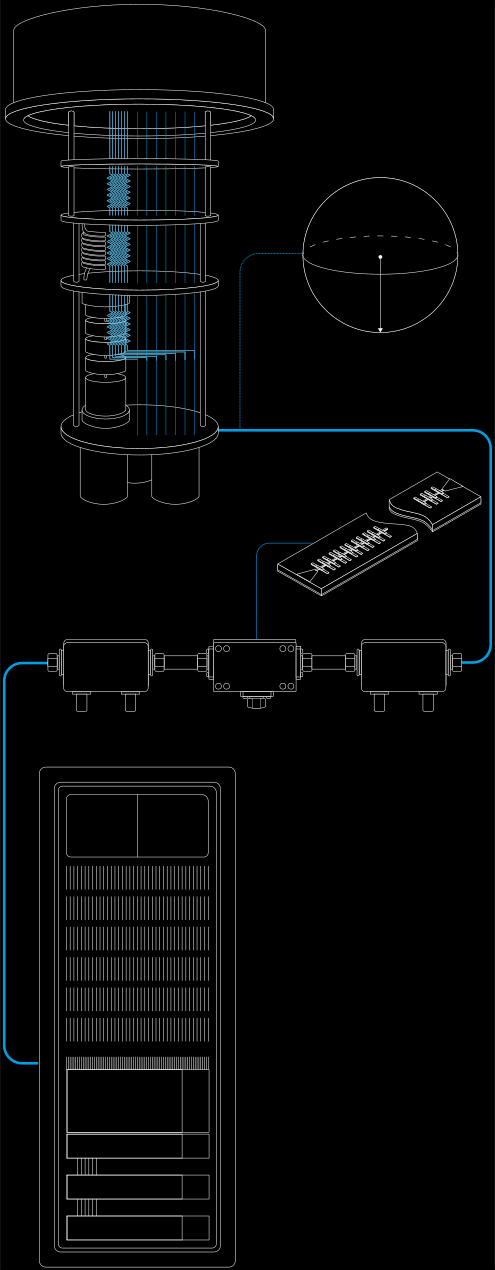
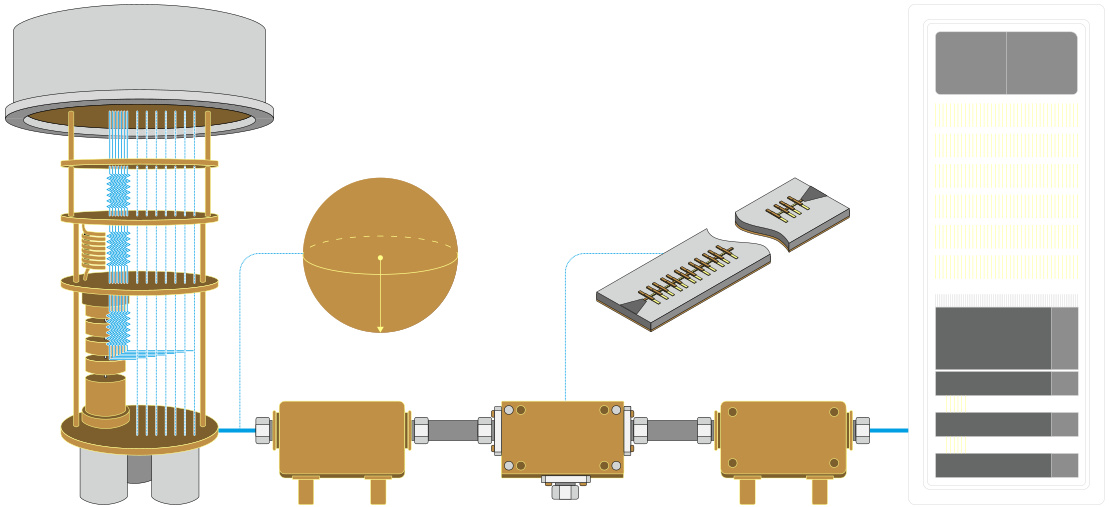
Preserving the information of the qubit’s state requires amplifying signals early in the chain, before loss and noise degrade them beyond recovery. Located inside the cryostat, quantum amplifiers operate close to the quantum limit of added noise at millikelvin temperatures (10mK). They amplify signals while maintaining their integrity, enabling accurate state discrimination, even in dense, multiplexed environments.
TWPAs: a scalable approach to readout
Among cryogenic amplifiers, TWPAs are particularly well suited for scalable systems. They are based on nonlinear superconducting transmission lines composed of thousands of Josephson junctions. As microwave signals propagate along the line, energy from a pump is transferred to the signal, resulting in continuous amplification. This traveling-wave architecture enables high performance over wide bandwidths, making TWPAs compatible with multiplexed readout.
5 parameters
define TWPA performance
Designed for reliable readout
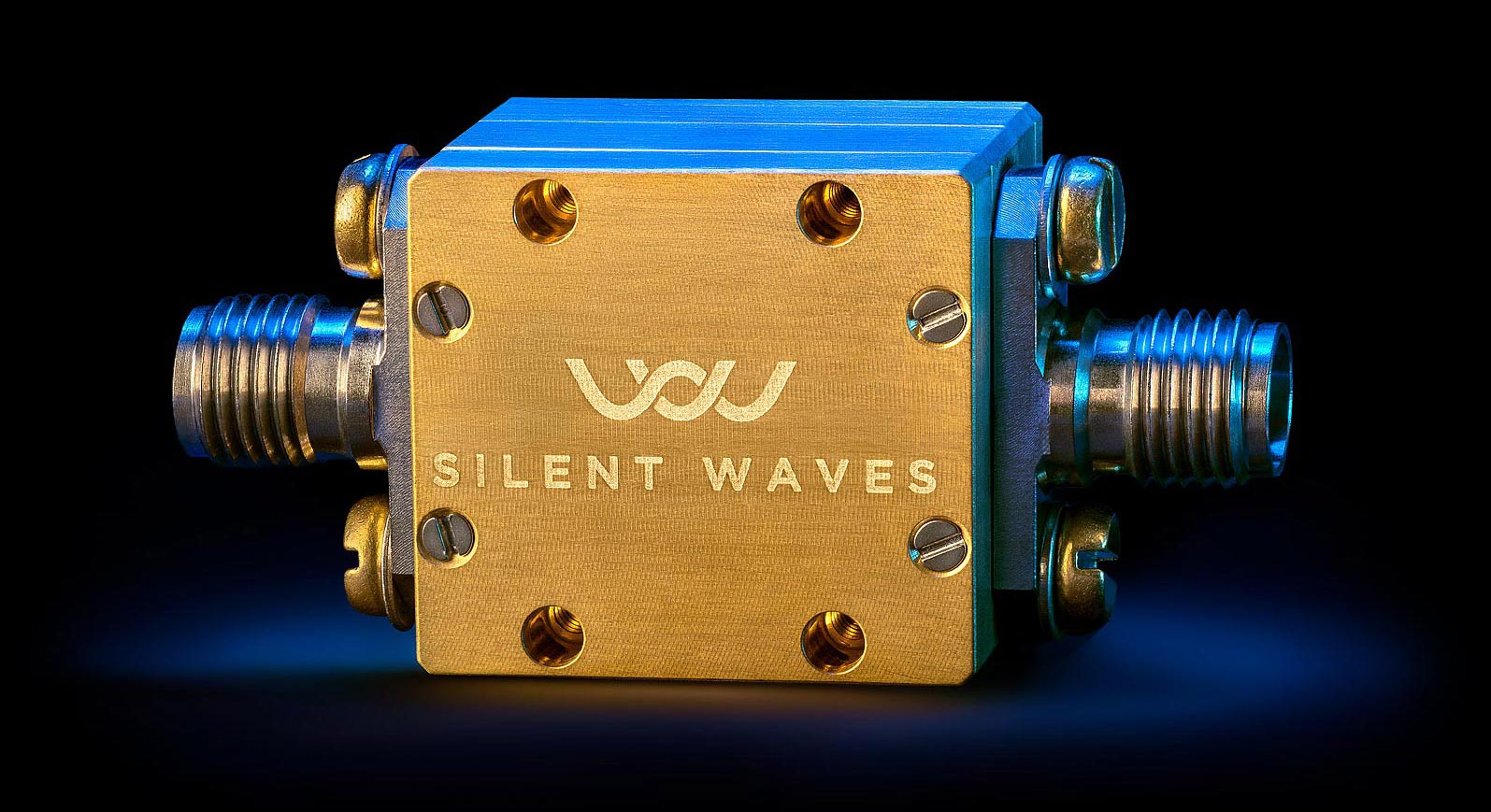
Silent Waves TWPAs are designed for multiplexed qubit readout, where readout fidelity and reliability are critical. They combine high net gain, wide bandwidth, high saturation power, and near quantum-limited noise performance to support real quantum systems.
Manufacturing
Installation
After-sales Support
The Zephyr: an integrated solution
In 2026, Silent Wave launched its latest compact TWPA solution, designed for cryostats with limited space. Integrating an Argo TWPA and microwave coupler into a single device, the Zephyr reduces the overall footprint while maintaining high-performance quantum readout.
More integration on the horizon
Current readout chains rely on multiple discrete components, increasing loss and system complexity. Silent Waves is developing TWPAI, a device that integrates amplification, isolation, and coupling into a single compact solution. This approach reduces footprint, minimizes loss, and simplifies cryogenic system integration.
Solid research supports Silent Waves’ TWPA technology
Silent Waves technology builds on more than a decade of academic research in quantum microwave parametric amplification. We bring together a team of internationally-recognized experts in the readout field. All our technologies are based on research published in esteemed peer-reviewed journals.
Some of the landmark publications are:
-

Photonic-crystal Josephson traveling-wave parametric amplifier
Luca Planat et al. 2020, Physical Review X -

Kerr reversal in Josephson meta-material and traveling wave parametric amplification
Arpit Ranadive et al. 2022, Nature Communications -

A travelling-wave parametric amplifier isolator
Ranadive, A., Fazliji, B., Le Gal, G. et al. 2025, Nat Electron -

Perspective on traveling wave microwave parametric amplifiers
Martina Esposito et al. 2021, Appl. Phys. Lett
FAQ
An ultra-low-noise amplifier is a device designed to strengthen very weak electrical signals while adding as little additional noise as possible.
In quantum computing systems, ultra-low-noise microwave amplifiers are used in the qubit readout chain to preserve measurement accuracy. Traveling-Wave Parametric Amplifiers (TWPAs) are a type of ultra-low-noise amplifier capable of operating close to the quantum noise limit.
A TWPA (Traveling-Wave Parametric Amplifier) is an ultra-low-noise microwave amplifier used to amplify extremely weak signals, especially in superconducting quantum computers. TWPAs rely on non-linear transmission lines, which enables broader bandwidth than previous counterparts
A Josephson amplifier is a superconducting microwave amplifier based on the nonlinear properties of Josephson junctions to amplify microwave signals. These amplifiers operate with extremely low added noise and are commonly used in quantum measurement systems. J-TWPAs are a specific type of Josephson amplifier designed for wide bandwidth and high gain.
A TWPA is a microwave superconducting amplifier, while a HEMT amplifier is a semiconductor microwave amplifier. TWPAs operate closer to the quantum limit of noise and are placed early in the cryogenic amplification chain. HEMT amplifiers operate at higher temperatures and add more noise, so they are typically used after the first stage of amplification.
TWPAs are used in solid-state quantum computers to amplify extremely weak qubit signals and improve their Signal-to-Noise Ratio (SNR), in turn increasing their readout fidelity. Qubit readout is done with microwave signals that are too weak to be detected with conventional electronics. By amplifying these signals with minimal added noise, TWPAs improve measurement fidelity and enable fast and multiplexed qubit readout in large-scale superconducting quantum processors.
Typical Josephson Traveling-Wave Parametric Amplifiers provide between 15 dB and 25 dB of gain. This amplification boosts weak qubit signals before they reach higher-temperature electronics. The exact gain depends on the device design and operating frequency, but this range is sufficient to significantly improve the signal-to-noise ratio.
Most TWPAs provide high bandwidths of 1 GHz or more. Wide bandwidth allows multiple readout tones to be amplified by the amplifier simultaneously. This capability is important for multiplexed qubit readout, where many qubits are measured through a single microwave readout line.
TWPAs are installed inside dilution refrigerators at the same temperature stage as the quantum processor. They operate at cryogenic temperatures and are placed early in the microwave readout chain. Amplifying the signal at this stage preserves high readout fidelity before additional noise is introduced by higher-temperature electronics.
Saturation power is the signal power level at which the TWPA gain begins to drop. When the input signal approaches this limit, the amplifier’s gain starts to compress. Saturation power determines how many readout tones or qubits can be measured simultaneously. Higher saturation power allows larger multiplexed quantum systems to operate without degrading measurement accuracy.
Quantum-limited amplification refers to amplifiers that add noise close to the minimum level allowed by the laws of quantum mechanics. In microwave quantum systems, this limit is often described as approximately one photon of added noise. Amplifiers that operate near this limit are critical for achieving high-fidelity measurements in quantum computing experiments.
A TWPAI is a cryogenic device that combines a TWPA with microwave isolation features. Traditional quantum readout chains require separate amplifiers, isolators, and couplers. By integrating these functions into a single device, a TWPAI can reduce system footprint, simplify cryogenic installation, and reduce signal losses in the readout chain, improving readout fidelities.
The Argo is Silent Waves’ landmark product. These cryogenic microwave amplifiers are designed to provide high gain, wide bandwidth, and near-quantum-limited noise performance. Argo devices are used in quantum processor readout chains to improve measurement accuracy and enable scalable qubit multiplexing.
Silent Waves is a quantum hardware startup based in Grenoble, France. The company originated from research conducted at the CNRS Néel Institute, a major laboratory in superconducting electronics and quantum physics. Silent Waves develops cryogenic microwave technologies used in quantum computing readout systems